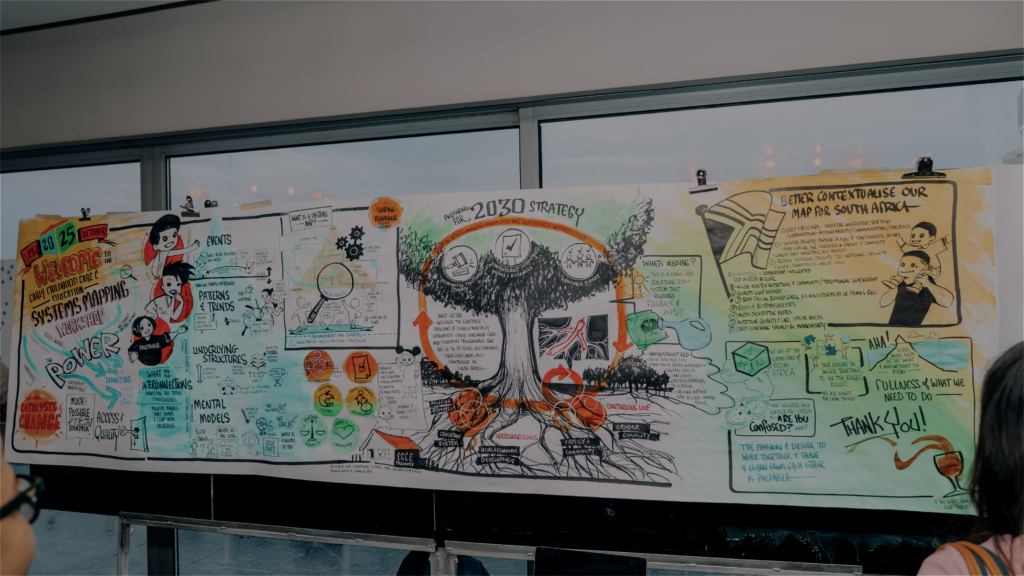
In October 2025, SmartStart, the Department of Basic Education, Ilifa Labantwana, Harambee Youth Employment Accelerator and ECDAN convened a two-day Early Childhood and Care Systems Mapping Workshop with practitioners, parents, government officials, civil society organisations, funders, academics and international partners to examine how South Africa’s ECCE system works in practice, and what it will take for universal access to become a reality.
South Africa’s recent commitments in ECCE are significant and worth naming. The 2030 Strategy for ECD Programmes, the Children’s Amendment Bill, the mass registration drive, and the newly published Bana Pele Shared Blueprint — which calls for a shift from slow, linear progress toward rapid, exponential transformation — reflect a sector that is moving. And yet too many children, particularly those in the most marginalised communities, are still not reached.
What the room surfaced was more layered than a simple diagnosis of what is broken. The systems mapping process revealed a sector with genuine momentum alongside deep structural friction — and being honest about both matters.
The bright spots are real. ECCE is rising as a political priority, reflected in recent policy shifts. Public awareness is growing. Strengthened data systems are improving planning. Active advocacy coalitions are beginning to align around shared priorities. And informal home and community-based programmes, operating in the most marginalised and hard-to-reach areas, continue to reach children who would otherwise have no access to early learning at all.
But the frozen points are equally real, and they are stubborn. Inequality continues to drive uneven access. Compliance barriers stall the expansion of affordable quality programmes. Children with disabilities are still excluded. And system fragmentation creates silos that dissipate effort rather than allowing it to add up to something greater.
The women who deliver early learning — as practitioners and as the parent figures making daily decisions about their children’s care — carry a weight that the system rarely acknowledges. For practitioners, this invisibility shows up in low wages, weak support and high attrition. For caregivers, it shows up in the absence of information, services and genuine support that would free them to make real choices about their own lives.
What the workshop also surfaced is where the catalytic leverage lies. We identified a set of shifts that, if unlocked, could move multiple parts of the system simultaneously — sustainable public financing; regulatory reform that supports diverse delivery modalities; stronger investment in practitioner development and remuneration so that ECCE practice becomes a viable, recognised profession; and more deliberate partnerships between the state and those who support delivery — because while government is the duty bearer, universal access cannot be achieved without partners, and those relationships need to be better structured and more intentionally supported.
The systems mapping process offers a shared picture of how the system actually works — who connects to whom, where effort is being absorbed without impact, and where a shift in one place could unlock movement in others.
The full report is available on our website and can be accessed using the button below. We share it as a tool for ongoing learning and alignment — and as an invitation to keep having this conversation, collectively.