20 October 2026

The early learning challenge is too big for any one organisation to solve alone.

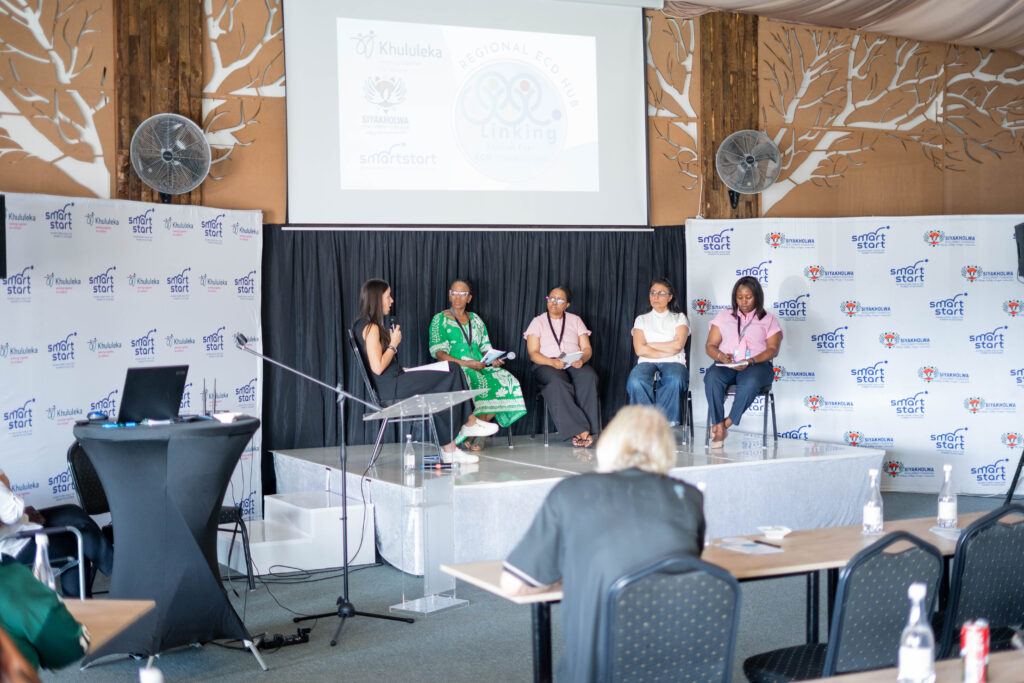
That is why, in the Eastern Cape, two SmartStart franchisors have come together alongside like-minded organisations, government and other partners to launch the Eastern Cape ECD Regional Hub. The hub is not simply a new structure. Rather, it is a commitment to better coordination: bringing partners together, aligning support and making it possible for more children to access quality early learning.

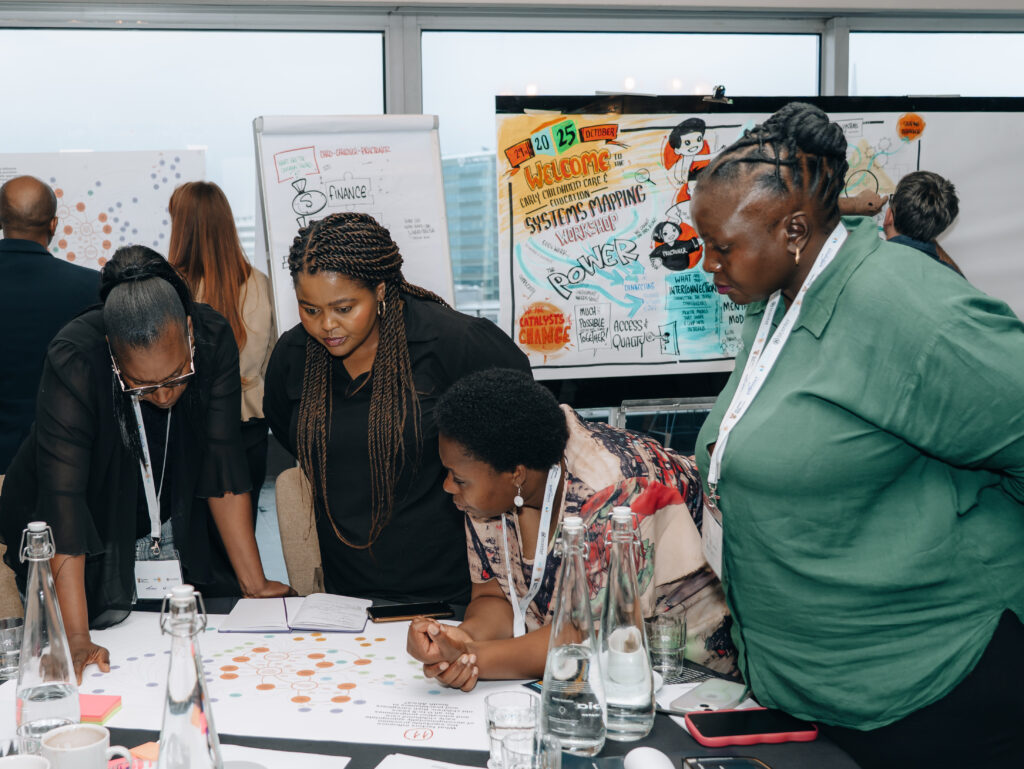
Khululeka and Siyakholwa gathered with NGOs, provincial government representatives, funders and community leaders to launch something harder to photograph than a building, but just as important: a regional hub for early childhood development whose first product is not a service, but coordination.

Stories of a “hub” launch often invoke an image of a ribbon-cutting: a new centre, a new programme, a new logo on a wall in KuGompo or Komani. This is not that type of story. Khululeka and Siyakholwa gathered with NGOs, provincial government representatives, funders and community leaders in the Eastern Cape to launch something harder to photograph than a building and, we believe, just as important: a regional hub for early childhood development whose first product is not a service, but coordination.

The truth that our sector does not always say out loud is that fragmentation has a cost. Organisations with the same mission sometimes work in the same villages, duplicating assessments, training and outreach. This is not intentional but often a response to symptoms of the same system and not looking fully at the whole picture.

The Eastern Cape makes this hard to ignore. It is one of South Africa’s most rural provinces, and many children still live outside registered, well-supported early learning provision. Against this scale, a siloed approach to addressing some of these challenges will not yield the desired outcomes in the long term.

That is why two franchisors came together around a shared conviction: the scale and complexity of this problem cannot be solved alone. Not by us nor by government alone. In fact, not by any one of us.

The hub has four jobs:

• Reduce duplication: align who does what, and where, so scarce resources go further.

• Align systems and data: build a shared evidence base so decisions respond to need, not habit or territory.

• Strengthen provincial capacity: connect NGOs, government departments and communities into one working ecosystem, rather than parallel silos.

• Build sustainability: create coordination that can outlast a single project, donor cycle or political term.

The hub is deliberately a platform, not an institution. Its value lies in removing friction between people and organisations that already care, already work and already know the terrain.

One of the most important ideas to come out of this gathering is a challenge to the deficit frame that often shapes conversations about ECD rural contexts. The Eastern Cape’s rural character is frequently described only as an obstacle: distance, poverty, infrastructure gaps. At the launch, the general tenor from all speakers was that the opportunities exist and that rural realities can be transformed into opportunities.

Decentralised networks of community-run early learning, women-led micro-enterprises and local knowledge that no head office can replicate are real strengths. A well-coordinated hub does ignore rural complexity but rather helps turn it into a delivery advantage.

The ideas that underpin the hub are, broadly, aimed at chipping away some of the systemic drivers of exclusion across the province. For the children for whom this hub exists, they will experience it in simpler ways: a practitioner who receives training instead of being missed; a centre that becomes registered instead of excluded; a mother who finds a place for her child where none existed before. This is the version of “no child left behind” that must live in all of us as a working agreement.

The hub now moves from launch to labour: mapping the ecosystem, aligning data standards and establishing the partnership governance needed to hold us to the commitments made this week.

To the NGOs, officials, funders and community leaders who joined us: thank you. The hub belongs to all of us. It will only work if we make it work.
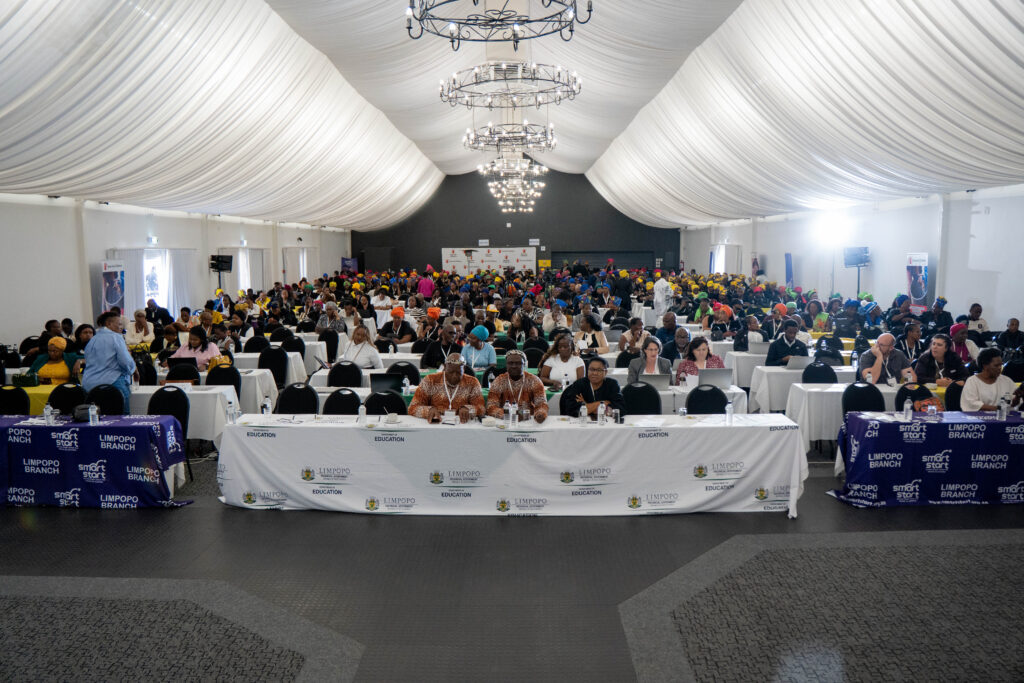
3 September 2026

The two-day Limpopo Provincial ECD Multi-Stakeholder Indaba, organised in partnership with the Limpopo Department of Education and Save the Children South Africa, brought together government departments, municipalities, practitioners, traditional leaders, communities, parents, civil society, donors and private-sector partners.

The Indaba focused on a practical question: what will it take to reach more children in Limpopo with quality early learning, particularly in rural and underserved communities?

Participants identified priorities including stronger coordination between government and ECD providers, improved infrastructure and essential services, better support for practitioners, more responsive community participation, and better alignment of resources around children’s learning, safety and wellbeing.

A central message throughout the discussions was that no single organisation or department can deliver universal access to quality early learning alone. Progress will depend on partners working together with clear roles, shared priorities and a commitment to turning plans into action.

The conversations will inform the development of a Provincial ECD Action Plan, setting out commitments, responsibilities, timelines and measures of progress.

For SmartStart, the Indaba was an opportunity to contribute our experience of working with practitioners, partners and communities, while listening to the priorities shaping ECD in Limpopo. It also reinforced the value of bringing different perspectives into the same room: practitioners bring insight from daily delivery, communities share local realities, government outlines system priorities, and partners explore how they can contribute to a more coordinated response.

The work now is to build on this momentum by strengthening relationships, supporting implementation and turning shared ambition into meaningful progress for children and families across Limpopo.

Learn more about SmartStart’s work with partners and communities to expand quality early learning.

14 August 2026

SmartStart brought together its national network and the wider early childhood development (ECD) ecosystem for its inaugural Constellations of Change gathering in Johannesburg. The two-day event explored how stronger partnerships can help make quality early learning accessible to every child by 2030.

The gathering brought together implementing partners, programme leads, club coaches, call-centre agents, frontline and hub staff, government representatives, funders, researchers, technology providers and other stakeholders. It reflected SmartStart’s role as an early learning delivery platform that connects people, organisations and resources to strengthen access, quality and sustainability across the sector.

The first day focused on SmartStart’s network and its new five-year strategy. Partner leaders, their teams and SmartStart staff reflected on SmartStart’s evolving role – from delivering an early learning programme to acting as a catalyst for greater coordination, innovation and systems change.

Participants also celebrated the network’s contribution to SmartStart’s recognition as a 2026 recipient of the Skoll Award for Social Innovation. Four partner organisations were recognised for agency, know-how and collaboration:

The second day opened the conversation to the wider ECD system. Government leaders, funders, researchers, technology providers and implementing organisations considered the conditions needed to expand access and improve the quality and sustainability of early learning.

Panel discussions explored the links between access, nutrition, quality, the ECD workforce, financing, evidence-building and partnerships. They highlighted that universal access to quality early learning cannot be achieved by one organisation alone: nutrition supports children’s ability to learn; quality depends on a skilled and supported workforce; and sustaining that workforce requires appropriate financing, informed by evidence and strengthened through partnerships.

The gathering concluded with a shared commitment to strengthen collaboration across the ECD ecosystem and include more voices in the work ahead. The next phase will focus on translating conversations into action through stronger partnerships with government, more coordinated investment, shared evidence and opportunities for organisations across the sector to contribute.

Explore how SmartStart works with implementing partners to strengthen early learning delivery across South Africa.

21 July 2026

What does it take to ensure that every child in South Africa has access to quality early learning?

The answer cannot be found in one programme, organisation, or solution. It lies in the connections between the many people and parts of the early childhood development ecosystem – from families and practitioners to government, funders, researchers, technology providers, and community organisations.

This is the thinking behind Constellations of Change, a two-day gathering hosted by SmartStart on 11 and 12 August 2026 at Emperors Palace in Kempton Park, Johannesburg.

SmartStart’s work is rooted in a simple belief: every child deserves the opportunity to learn, grow, and thrive.

To reach every child, however, requires more than expanding individual programmes. It requires a stronger and more connected system – one where organisations share knowledge, build on one another’s strengths, and work towards a common purpose.

Constellations of Change will bring the SmartStart network together to reflect on the organisation’s journey, look ahead to its new five-year strategy, and explore SmartStart’s evolving role as a system catalyst.

The gathering will also create space to recognise the people and partnerships that make the work possible every day.

The first day will focus on the SmartStart network, bringing together implementing partners, programme leads, club coaches, frontline teams, contact-centre agents, and hub staff.

These are the people who support early learning delivery across communities. They recruit, train, coach, coordinate, problem-solve, and help create the conditions in which practitioners can support children.

The day will be an opportunity to:

  • Reflect on what the network has learned.
  • Connect around SmartStart’s five-year strategy.
  • Explore the shift from programme implementer to system catalyst.
  • Share ideas and experiences from across the network.
  • Celebrate the work of partners and teams.

The day will conclude with a gala dinner celebrating the network’s contribution to SmartStart’s recognition as a 2026 Skoll Award for Social Innovation recipient.

The second day will bring together the wider ECD ecosystem.

Government leaders, funders, researchers, technology providers, implementing organisations, and other partners will be invited to join the conversation about what it will take to expand access to quality early learning across South Africa.

The programme will explore the connections between:

  • Access
  • Nutrition
  • Quality
  • The ECD workforce
  • Financing
  • Data and evidence-building
  • Partnerships

These areas cannot be addressed in isolation. Access to early learning is connected to children’s health and nutrition. Quality depends on a skilled, supported, and sustainable workforce. Supporting that workforce requires appropriate financing, guided by evidence and strengthened through partnerships.

The event will ask how the ecosystem can move from working alongside one another to working more intentionally together.

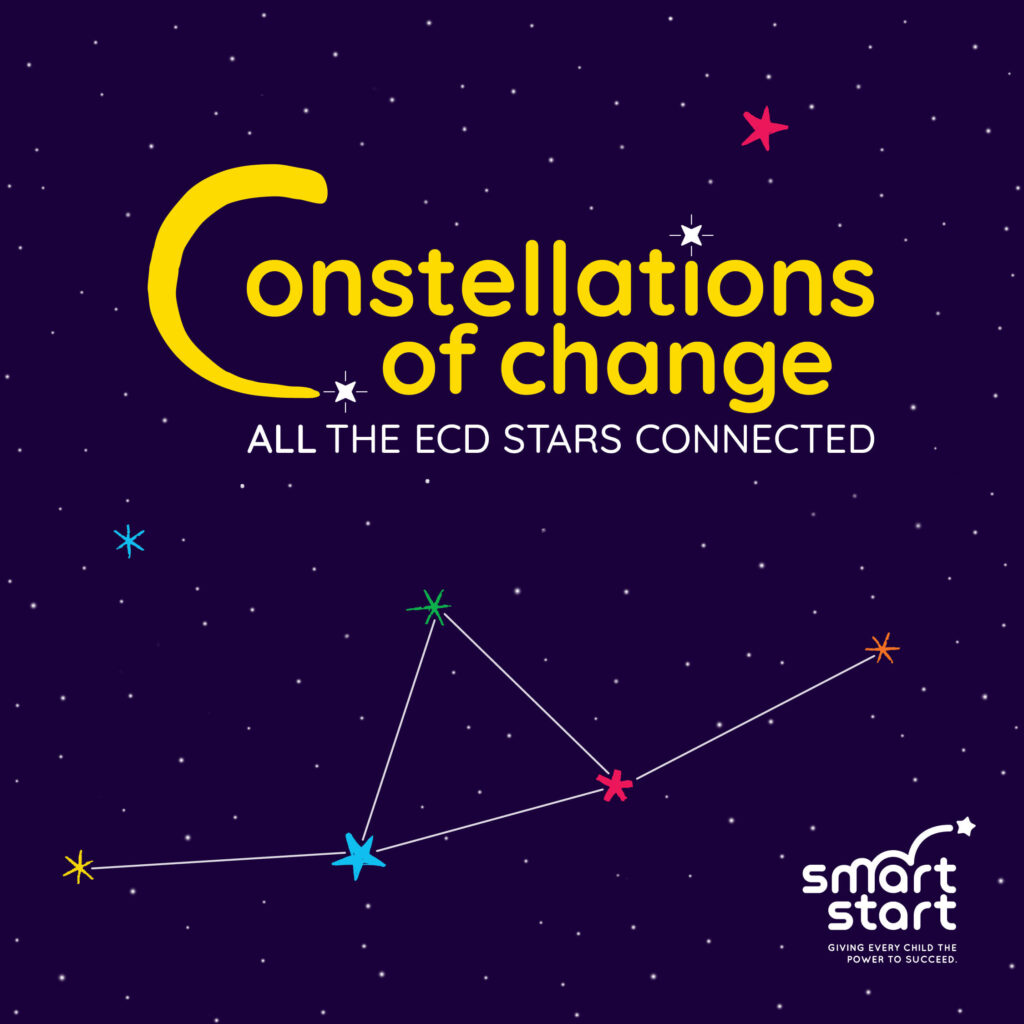
A constellation is made up of individual points. Each point matters, but the pattern becomes visible only when the points are connected. The same is true of early learning. Every practitioner, family, organisation, funder, researcher, policymaker, and community leader has a role to play. Their work may look different, but it contributes to a shared system.

The question is not only what each organisation can do on its own. It is also:

  • Where can we work together?
  • How can we share what we are learning?
  • How can we reduce duplication?
  • How can we strengthen the parts of the system that support everyone?
  • How can we turn evidence into action?
  • How can we ensure that the voices of communities and practitioners shape the future of ECD?

Constellations of Change is not intended to be a conversation for its own sake but an opportunity to build relationships, surface important questions, and identify practical ways to strengthen the early learning ecosystem.

SmartStart’s next chapter will depend on its ability to work with others – not only as a delivery platform, but as a partner in building a more connected, coordinated, and effective system. The work ahead is complex. But the opportunity is significant.

When the different parts of the ecosystem connect, they can create something stronger than any one organisation could create alone: a future in which every child has access to quality early learning. That is the constellation we are working to build.

25 November 2025

SmartStarters Unite provincial events across the country built momentum for the Power Circle: Children, Women, Community, a landmark SABC 2 special broadcast celebrating 10 years of SmartStart and the broader early childhood development sector’s potential through united action.

The national finale showcased collective leadership transforming ECD when women, parents, communities, government and social partners align. The Power Circle elevated SmartStarters Unite from local celebrations to national conversations.Featuring voices from the entire ECD ecosystem (provincial municipalities, traditional leaders, parents, teachers), it showcased live panels and stories – proving that collective action unlocks child potential.

24 November 2025

SmartStarters Unite events across all provinces brought together thousands of SmartStarters, parents, children, partners, ECD forums, traditional leaders, government stakeholders, and communities to honour 10 years of SmartStart transforming South Africa’s ECD landscape.

Nationwide celebrations, local stories

From East London to Durban, hundreds of awards celebrated outstanding SmartStarters and their clubs. SmartStarters shared moving testimonies of personal transformation – from humble beginning in their living rooms to community leadership – proving women closest to the challenge deliver its greatest solutions.

Strategic partnerships powered 10 events

Provincial SmartStarters Unite events were held in collaboration with:

  1. Eastern Cape – Khululeka and Siyakholwa Development Foundation
  2. Free State – Lesedi Educare Association
  3. Gauteng – Lima Rural development and Siyakholwa Development Foundation
  4. KwaZulu-Natal – Letcee, Project Preparation Trust (PPT) and Training and Resources in Early Education (TREE)
  5. Mpumalanga – Penreach
  6. Northern Cape – 3L
  7. Western and Southern Cape – ELRU and Little Seeds
  8. Limpopo and North West – Provincial SmartStart branches

Province-by-Province highlights

Gauteng: Men breaking ECD stereotypes

Orlando East, Soweto in front of 3 000 attendees, Moremane Derick (Atteridgeville) and Siyabonga Mndebele (Orange Farm) challenged male underrepresentation. “Caregiving isn’t women only work, they stated, calling for greater male recruitment to shift perceptions.

Free State: Grace Matlhape’s partnership vision

SmartStart CEO Grace Matlhape attributed the organisation’s decade-long success to collaborative partnerships while flagging that 1.3 million children still lack access. “ECD is everyone’s responsibility, not just government’s.”

Eastern Cape:

Tafara Shuro (Siyakholwa) honoured SmartStarters’ sacrifices reaching remote areas.Mary Venter (Siyakholwa celebrated sustainable futures via regional hubs.

Mpumalanga: ECD coordinator calls for unityThembi Nkadimeng (Nkangala ECD Forum) invited SmartStarters to join the forum saying, “If we stand for children, we need to unite”.

Northen Cape: Community growth

Councillor Arlene Bosman (Sol Plaatjie) said she was “looking forward to welcome more ECD practitioners to grow Northern Cape children.

Western Cape: The foundation is “love”

SmartStarters Maria Viewer (Mangaliso, George): “With love, anything is possible.” and Elsabe Speelman (Mandela Village), who sheltered children during eviction protests, “I became a light in dark times.”

KZN and Limpopo: Traditional leadership shows support

Ndlunkulu Mamohale Buthelezi highlighted the importance of cultural preservation in early learning, noting the role of indigenous language, storytelling, and singing in nurturing good citizenship among children.

Chief Humprey Magakula: “If we had ECD programmes like this in the last 30 years, we as a nation would have been much further.” He called for traditional, government and community partnerships for accelerated ECD access.

Over 15 000 SmartStarters operate in low-income areas where little to no early learning services are available. Using their homes and other community spaces, women (and some men) from these communities – with training and support – establish early learning enterprises to serve excluded children with dedication, understanding the profound impact on children, families and their communities.

We've won the 2026 Skoll Award for Social Innovation! Recognised for expanding access to quality early learning across South Africa. Find out more →