14 October 2026

Most children meet art the same way they meet music: a picture on a wall, a museum trip, or a single famous name like Van Gogh. That’s enough to spark something. The questions below cover what parents, teachers, and grandparents actually ask when they want to turn that spark into a habit – without turning it into homework.

What age can children start learning art history?

Four is fine, if you keep it sensory. At that age, art history isn’t dates or movements – it’s colour, texture, and story. A four-year-old can compare a gold Byzantine mosaic to a bright Matisse cut-out and say which one feels louder. That comparison is the whole skill in seed form.

Between seven and ten, children start caring about people and motives. That’s the sweet spot for “who made this and why.” A ten-year-old will happily argue about whether a portrait shows a proud king or a nervous one, especially if you ask them to point at the evidence in the painting.

Teenagers can handle context: wars, patrons, money, censorship. They often respond well to art that broke rules – Dada, graffiti, protest photography – because the rebellion is legible to them.

Do we need to visit a museum to make this work?

No. Museums are wonderful, but they’re also tiring, expensive, and often far away. A kitchen table, a printer, and a tablet cover most of what matters at the start.

What a museum does add is scale and material presence. Standing in front of a Rothko or a carved Benin plaque teaches something a screen can’t: how big the thing really is, and how the surface catches light. If you can go, go once or twice a year and keep the visits short. Ninety minutes beats four hours, every time.

If you’d rather build a structured plan first, fisip.untad.ac.id is a useful reference point for reading around the subject and finding how art, culture, and society connect in formal study.

Which artists should we start with?

Pick artists with strong visual signatures and messy human stories. Children remember personalities far better than periods.

  • Vincent van Gogh – thick paint, wild yellow, a life full of struggle. Kids connect with the emotion instantly.
  • Frida Kahlo – self-portraits, animals, pain turned into pictures. Endlessly discussable.
  • Katsushika Hokusai – waves, mountains, and a man who reportedly called himself “the old man mad about drawing.”
  • Yayoi Kusama – dots, mirrors, and rooms you can walk inside. Great for very young children.
  • Romare Bearden – collage made from cut paper and photographs, which doubles as a craft project.

Five artists, one per month, gives you a year of conversation. You don’t need fifty.

How do we actually study a painting together?

Use three questions in order, and don’t rush to the third.

What do you see? Stay literal. Colours, shapes, faces, weather, what’s in the corner. This step is longer than adults expect – a child might list twenty things before they interpret anything.

What’s happening? Now they narrate. Let them be wrong. A child who thinks the woman in a Vermeer is waiting for someone is doing real art-historical work: reading gesture, light, and setting.

What does it make you feel? Feelings are the payoff. If a painting makes someone uneasy, that’s information, not a failure.

After the looking, make something. Copy the painting badly on purpose. Cut it into strips and rearrange it. Paint the same scene at night. The making is what turns looking into memory.

For families who want ready-made activities rather than building them from scratch, odkrywamyzakryte.com collects ideas in this vein and is worth browsing when you need something for a rainy afternoon.

How do we avoid turning it into a chore?

Follow the child’s attention, not a syllabus. If they spend forty minutes on dragon paintings from Japan and never touch the Renaissance, that’s a good month. Nobody’s exam depends on it.

Keep sessions short and end them while things are still fun. Twenty minutes once a week beats a two-hour Sunday lesson that everyone dreads.

Let them dislike things. A child who says “this is boring” about a Renaissance altarpiece has made an aesthetic judgement, and you can ask what would make it less boring. That question is more valuable than any fact you could have taught them.

Finally, put their own work on the wall. A drawing taped at eye level next to a printed Monet says something no lecture can: that they belong in the same conversation. Programs like All-change take a similar approach, treating a child’s own making as the doorway into the wider history rather than a reward for finishing it.

What if I don’t know much about art myself?

Then you’re the ideal guide, because you’ll model curiosity instead of authority. Say “I don’t know why the sky is green there – let’s find out” and look it up together. Children learn more from watching an adult wonder out loud than from hearing an adult recite.

Start with one painting this week. Ask what’s happening in it. See where the conversation goes.
21 July 2026

What does it take to ensure that every child in South Africa has access to quality early learning?

The answer cannot be found in one programme, organisation, or solution. It lies in the connections between the many people and parts of the early childhood development ecosystem – from families and practitioners to government, funders, researchers, technology providers, and community organisations.

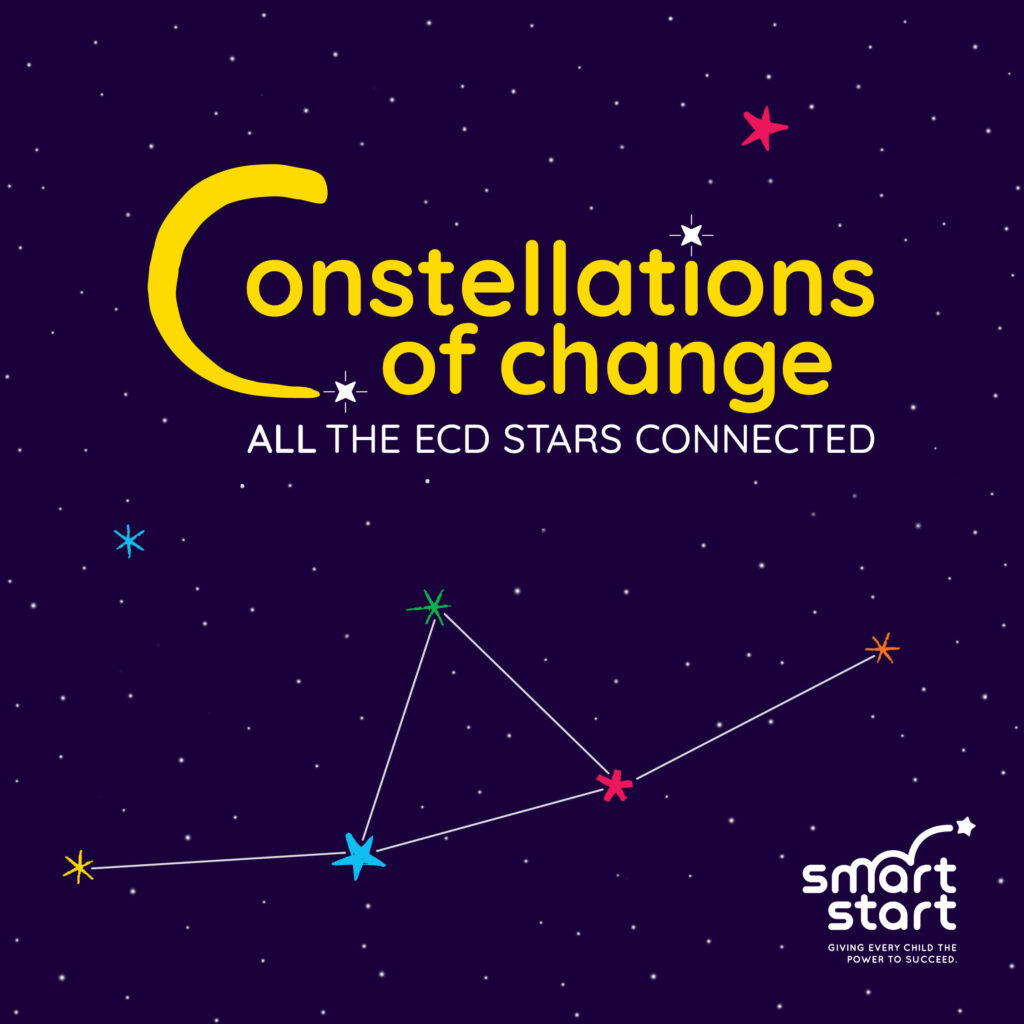
This is the thinking behind Constellations of Change, a two-day gathering hosted by SmartStart on 11 and 12 August 2026 at Emperors Palace in Kempton Park, Johannesburg.

SmartStart’s work is rooted in a simple belief: every child deserves the opportunity to learn, grow, and thrive.

To reach every child, however, requires more than expanding individual programmes. It requires a stronger and more connected system – one where organisations share knowledge, build on one another’s strengths, and work towards a common purpose.

Constellations of Change will bring the SmartStart network together to reflect on the organisation’s journey, look ahead to its new five-year strategy, and explore SmartStart’s evolving role as a system catalyst.

The gathering will also create space to recognise the people and partnerships that make the work possible every day.

The first day will focus on the SmartStart network, bringing together implementing partners, programme leads, club coaches, frontline teams, contact-centre agents, and hub staff.

These are the people who support early learning delivery across communities. They recruit, train, coach, coordinate, problem-solve, and help create the conditions in which practitioners can support children.

The day will be an opportunity to:

  • Reflect on what the network has learned.
  • Connect around SmartStart’s five-year strategy.
  • Explore the shift from programme implementer to system catalyst.
  • Share ideas and experiences from across the network.
  • Celebrate the work of partners and teams.

The day will conclude with a gala dinner celebrating the network’s contribution to SmartStart’s recognition as a 2026 Skoll Award for Social Innovation recipient.

The second day will bring together the wider ECD ecosystem.

Government leaders, funders, researchers, technology providers, implementing organisations, and other partners will be invited to join the conversation about what it will take to expand access to quality early learning across South Africa.

The programme will explore the connections between:

  • Access
  • Nutrition
  • Quality
  • The ECD workforce
  • Financing
  • Data and evidence-building
  • Partnerships

These areas cannot be addressed in isolation. Access to early learning is connected to children’s health and nutrition. Quality depends on a skilled, supported, and sustainable workforce. Supporting that workforce requires appropriate financing, guided by evidence and strengthened through partnerships.

The event will ask how the ecosystem can move from working alongside one another to working more intentionally together.

A constellation is made up of individual points. Each point matters, but the pattern becomes visible only when the points are connected. The same is true of early learning. Every practitioner, family, organisation, funder, researcher, policymaker, and community leader has a role to play. Their work may look different, but it contributes to a shared system.

The question is not only what each organisation can do on its own. It is also:

  • Where can we work together?
  • How can we share what we are learning?
  • How can we reduce duplication?
  • How can we strengthen the parts of the system that support everyone?
  • How can we turn evidence into action?
  • How can we ensure that the voices of communities and practitioners shape the future of ECD?

Constellations of Change is not intended to be a conversation for its own sake but an opportunity to build relationships, surface important questions, and identify practical ways to strengthen the early learning ecosystem.

SmartStart’s next chapter will depend on its ability to work with others – not only as a delivery platform, but as a partner in building a more connected, coordinated, and effective system. The work ahead is complex. But the opportunity is significant.

When the different parts of the ecosystem connect, they can create something stronger than any one organisation could create alone: a future in which every child has access to quality early learning. That is the constellation we are working to build.

29 May 2026

SmartStart’s work is rooted in a simple but powerful belief: every child deserves access to quality early learning from the start. In a recent feature with Business Minds Media, CEO Grace Matlhape shares more about the SmartStart’s vision, the importance of early learning in South Africa, and the role the organisation plays in helping to build stronger foundations for children, families, and communities.

The conversation highlights the scale of the challenge, but also the opportunity to create meaningful change by supporting practitioners, strengthening systems, and expanding access to early learning in communities that need it most. It is a reminder that investing in young children is about education along with dignity, equity, and long-term social impact.

Read the full article here: Grace Matlhape on Business Minds Media

6 May 2026

Insights and Pathways from the 2025 National Systems Mapping Workshop

In October 2025, SmartStart, the Department of Basic Education (DBE), Ilifa Labantwana, Harambee Youth Employment Accelerator, and the Early Childhood Development Action Network (ECDAN) convened a two-day Early Childhood Care and Education (ECCE) Systems Mapping Workshop. Early childhood practitioners, parents, government officials, civil society organisations, funders, academics, and international partners – all key role-players in children’s welfare, came together to examine how South Africa’s ECCE system functions in practice, and to identify the shifts necessary to reach every child, especially the most excluded. This took place in the context of significant strides towards the goal of universal ECCE access in recent years.

The report outlines key findings from the session, and highlights stakeholder insight on forging more deliberate public-private partnerships around shared goals. It calls for elevating the value of care work, centering families and communities in solutions and driving a fundamental mindset shift to make sustainable change a reality. 

Download Report

10 March 2025

Are you having difficulty presenting complex data? SmartStart uses think-cell, a Microsoft PowerPoint and Excel add-in software with dozens of features that enable users to quickly create complex data-driven charts, maintain a presentation’s structure with auto-updating agendas, and consistently round numbers in Excel sheets.

think-cell also makes it is possible to create professional charts such as waterfalls, Marimekkos and Gantts within a few minutes, and to automatically update them from linked Excel data. The agenda-building capability is similarly automated—maintaining a complete agenda in PowerPoint functions in the same manner as a table of contents in a good word processor. The Excel add-in enables consistently rounded numbers across both complex calculations and multiple work sheets.

For detailed information on think-cell and its features, or to get a better idea of how it works, visit www.think-cell.com.

Usage Terms

think-cell offer their software for FREE to academic or non-profit organisations, if the software is used for education, public research or their direct non-profit core operations only.

Contact

If you are eligible and agree to the Usage Terms above, please email sales@think-cell.com for more information.